 Priority ShippingPurity Analysis3rd Party TestingUSA Manufactured
Priority Research Peptides
GHK-CU
Dermal & Tissue Research
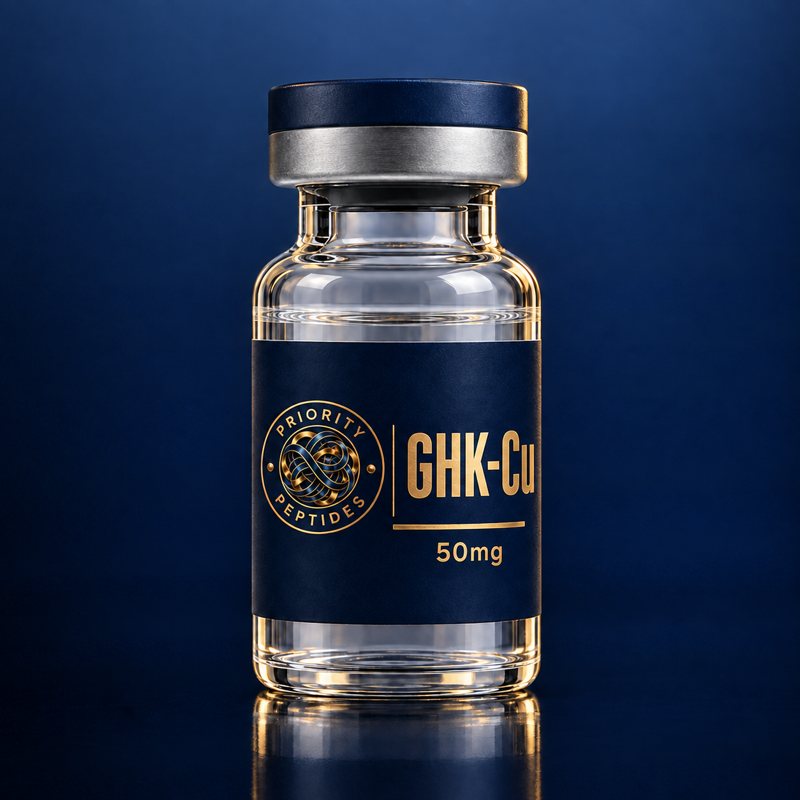
GHK-Cu (Copper Tri-peptide-1) is a naturally occurring copper complex with broad research applications in skin biology, wound healing and anti-aging science. It is supplied as a lyophilized powder for controlled laboratory investigation. It is formulated as Glycyl-L-Histidyl-L-Lysine complexed with Cu2+, it is characterized in peer-reviewed literature for its role in extracellular matrix signaling, copper coordination chemistry, and multi-pathway cellular biology research. It is supplied at 50 analytical mass units with >or = to 99% purity. Not for consumption, parenteral administration or any other application outside of a controlled laboratory setting.
COMPOUND FORMULATION AND LABORATORY HANDLING
The research compound is supplied as a freeze-dried lyophilized powder intended for laboratory preparation. This supports compound stability and flexible handling within research protocols. Lyophilized preparation helps maintain structural stability and integrity during storage and transport.
Prior to experimental use, laboratories reconstitute the powder according to internal protocols using appropriate research-grade solvents. Careful preparation and handling help preserve compound integrity and support reliable results across repeated studies.
For storage, laboratories should keep the dry material in a cool, dry place away from direct light. Proper storage conditions help preserve the stability of GHK-Cu throughout the research period.
Quality Standards for Research Compounds
Each batch meets pharmaceutical-grade quality standards to support consistency and reliability in research supply. Independent testing and batch documentation allow researchers to review material specifications prior to use. Each shipment includes a Certificate of Analysis that supports batch verification and material transparency.
Advancing Scientific Research with Peptides
Peptides continue to serve as essential components in modern research due to their flexibility, precision, and well-defined structures. In laboratory settings, researchers rely on peptides to examine biological mechanisms, evaluate molecular interactions, and refine experimental models with a high level of control. Their scalable nature and compatibility with advanced analytical techniques make peptides valuable across both foundational studies and ongoing research development, supporting consistent, reproducible outcomes in controlled scientific environments.
Key Benefits of Peptides in Research:
- Support precise investigation of cellular signaling pathways
- Enable targeted structure–function research at the molecular level
- Offer high specificity for controlled experimental design
- Adapt easily across a wide range of research applications
- Aid in studying protein interactions and biological responses
- Allow consistent and repeatable laboratory testing
- Integrate well with modern analytical and research methods
- Serve as foundational tools in biochemical and molecular research
In laboratory and animal studies, GHK-Cu has been shown to influence pathways related to collagen synthesis, tissue repair, wound healing, and extracellular matrix remodeling by interacting with fibroblasts and stimulating the production of structural proteins.
Scientific literature documents that GHK-Cu can modulate gene expression and signaling pathways involved in inflammation, antioxidant responses, and tissue remodeling, including effects on collagen, elastin, and glycosaminoglycan production.
GHK-Cu has been studied in in vitro and animal models to explore its roles in wound healing, skin regeneration, and modulation of inflammatory pathways. Some research extends into other organ systems where tissue repair and oxidative stress regulation are of interest.
In stock
For laboratory research use only. Not for human or veterinary use.
Back to catalogCompound reference
Technical specifications
Educational reference data is not a lot-specific guarantee. Obtain the applicable supplier COA and SDS before handling.
- Purity
- Not published. Priority lot-specific COA pending; no purity percentage is claimed.
- CAS Number
- 89030-95-5 (reference copper complex) Reference ↗
- Molecular formula
- C14H23CuN6O4+ (PubChem reference, charge +1; supplier form pending) Reference ↗
- Molecular weight
- 402.92 g/mol (same reference form; salt/hydration may differ) Reference ↗
- Amino acid count
- Supplier documentation pending.
- Sequence
- Supplier documentation pending.
- Synonyms
- Prezatide copper; Copper Tripeptide-1; GHK copper Reference ↗
- Physical forms
- Cataloged as lyophilized powder. Supplier-specific form and salt confirmation pending.
- Solubility
- Supplier-specific solubility data pending. No preparation protocol is provided.
- Storage
- Follow the vial label and supplier SDS. Supplier-specific storage conditions pending.
Safety Data Sheet
Supplier SDS pending. No Priority-issued or supplier-specific safety document has been uploaded for this product.
Request SDS